Is the 1947 Wheat Penny Value Higher Than You Think?
The 1947 Wheat Penny belongs to the Lincoln cent series produced by the United States Mint between 1909 and 1958.
This specific mintage attracts numismatic market researchers due to significant variations in preservation and the presence of specific minting defects.
Accounting for the volume of currency introduced into circulation in 1947 is essential for an objective 1947 Wheat Penny value assessment.

The coins were struck at three main facilities: Philadelphia, Denver, and San Francisco.
Mint Branch | Mint Mark | Mintage Quantity |
Philadelphia | None | 190,455,000 |
Denver | D | 194,750,000 |
San Francisco | S | 99,000,000 |
The total mintage reached 484,205,000 specimens.
The coin material consists of 95% copper and a 5% mixture of tin and zinc.
A standard specimen weighs 3.11 grams with a diameter of 19 mm.
Color Classification and Its Price Impact
Professional grading services, such as PCGS and NGC, classify copper coins into three surface condition categories.
Surface color correlates directly with market value, demonstrating a significant price gap between categories.
Brown (BN). These coins having lost more than 95% of their original luster.
They are valued at minimum market rates.Red-Brown (RB). Specimens retaining between 5% and 95% of their original copper color.
The value of such coins shows moderate growth upon reaching high Sheldon scale scores.Red (RD). Coins preserving more than 95% of their original mint luster.
Record sales being recorded specifically within this category.
The value dynamics when transitioning from RB to RD in MS67 condition can range from 300% to 800%.
Philadelphia Issue (1947 No Mint Mark)
Coins lacking a mint mark are traditionally considered the most common in circulation.
Most surviving specimens hold a grade below MS60, possessing only nominal value.
The price begins deviating significantly from base values upon reaching the MS65 RD state.
According to auction data, a 1947 coin in MS67 RD condition is valued at approximately 350–500 USD.
A record price for the Philadelphia issue was recorded in 2019.
A specimen in MS67+ RD condition was sold for 4,320 USD.
This price resulted from exceptional strike clarity and the absence of micro-scratches on the surface of Lincoln's portrait.
Statistics show an annual decrease of 2–3% in the number of MS67 coins available on the market due to their transition into private long-term collections.
Denver Issue (1947-D)
The Denver Mint produced the highest number of coins during this year.
Despite the mass production, the minting quality in Denver often exceeded Philadelphia standards.
Market indicators for 1947-D in medium preservation states remain consistently low.
The situation changes when moving to the MS67 RD grade.
The average price for a lot in MS67 RD condition currently stands at 150–250 USD.
The auction record for the 1947-D is fixed at the MS68 RD level.
In 2013, such a coin was realized for 1,410 USD.
Later trades confirmed the stability of demand for this grade, keeping the price within the 1,100–1,300 USD range.
The investment attractiveness of the Denver issue is lower than Philadelphia's, owing to a larger number of surviving high-quality specimens.
San Francisco Issue (1947-S)
The San Francisco issue is the smallest in 1947.
The mintage volume of 99 million pieces makes these coins rarer in the long term.
However, collectors in the 1940s mass-saved rolls of coins specifically with the S mark.
This resulted in an oversupply of MS65 and MS66 condition coins in the modern market.
A 1947-S coin in MS67 RD condition is valued on average at 120–180 USD.
A record amount was paid for a coin in MS67+ RD condition.
In 2016, a lot was sold at a Heritage auction for 1,175 USD.
Comparative analysis shows that the price for 1947-S grows slower than the Philadelphia issue, adding an average of about 1.5% per year for top grades.
Minting Errors and Varieties
Coins possessing technical defects arising during the production process hold special value.
Such specimens ignore standard price tables, being based on the uniqueness of the defect.
The most significant 1947 varieties include:
Doubled Die Obverse (DDO). Observed on the date digits and the letters of the "LIBERTY" inscription.
Value depending on the doubling prominence.
Faintly expressed DDOs in AU (About Uncirculated) condition cost from 20 to 50 USD.Repunched Mint Mark (RPM). Characteristic of the D and S issues.
The second strike of the die with an offset creates a visual effect of letter duplication.
Specimens featuring a clear RPM are valued at 15–75 USD depending on preservation.Die Cracks. Particularly valued are the so-called "BIE" errors, where a crack between the letters B and E in the word LIBERTY resembles the letter I.
The price of such coins varies from 5 to 15 USD.Off-Center Strike. Coins struck with an offset of 10% or more possess high value.
A specimen with a 50% offset while retaining the date can cost over 100–200 USD.
Grade (Sheldon Scale) | 1947 (P) | 1947-D | 1947-S |
MS63 RD | $5 | $3 | $3 |
MS64 RD | $12 | $8 | $8 |
MS65 RD | $25 | $18 | $15 |
MS66 RD | $60 | $45 | $35 |
MS67 RD | $450 | $220 | $160 |
MS67+ RD | $4,000+ | $800 | $600 |
Factors Influencing Annual Price Changes
Analysis of market cycles over the last 10 years revealed certain patterns.
The price for coins in MS63-MS65 condition remains static, fluctuating within inflation expectations (about 2% per year).
For MS67 grade coins, a correlation with the overall state of the economy and interest in alternative assets is observed.
During periods of economic instability, demand for certified coins grows, increasing the value of rare grades by 5–7% annually.
Upon the market appearance of new specimens receiving an MS68 grade, the price for existing MS67s may temporarily decrease by 10% due to the redistribution of major investor interest.
Comparative Rarity of Top Grades
The coin appraisal app reports allow for determining the real scarcity of coins.
Below are the data regarding the number of certified coins in top quality.
1947 (P): Only 27 specimens in MS67 RD grade and just 1 in MS67+. This explains the high auction value.
1947-D: Approximately 150 specimens in MS67 RD grade. Greater availability limiting the price.
1947-S: More than 200 specimens in MS67 RD grade. Lowest scarcity in the top class.
These figures confirm that coin rarity is determined not by total mintage, but by the number of surviving specimens in a specific condition.
Recommendations for Identifying Valuable Specimens
Following a strict algorithm is necessary for determining the potential value of a 1947 coin.
Checking for the presence of original luster is the primary action.
Coins extracted from circulation and having wear marks on the wheat ears or Lincoln's hair are worth no more than 5–10 cents.
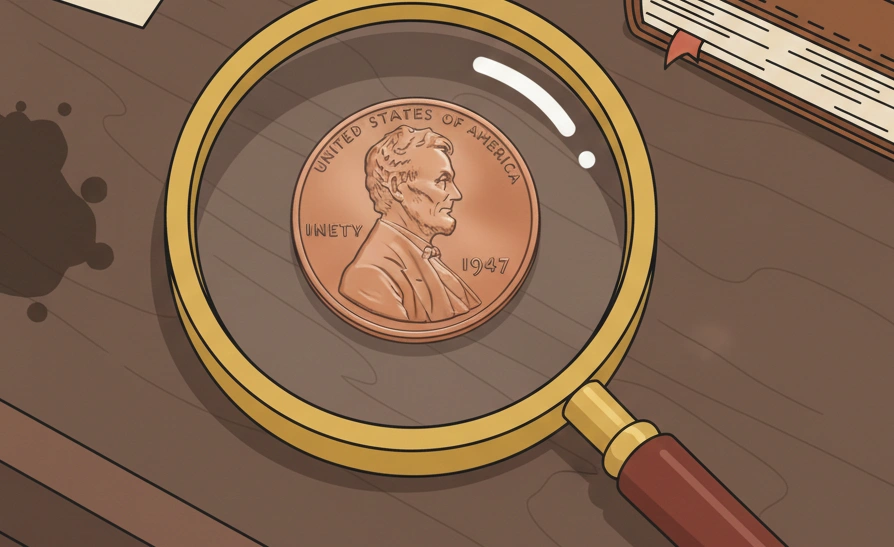
The second stage involves studying the mint mark under a magnifying glass with 10x magnification.
Discovering signs of die doubling significantly increases the estimated value even for a medium condition coin.
The third stage is a professional coin value app assessment of the field purity.
The presence of a single deep scratch on the obverse lowers the potential grade from MS67 to MS64, reducing market value by 30–40 times.
Conclusion
The 1947 Wheat Penny market demonstrates high segmentation.
Investment value is represented exclusively by coins in MS67 condition and higher, alongside rare minting errors.
Mass-produced specimens remain affordable material, showing no significant price growth over decades.
Confirmed sales facts indicate that the 1947 Wheat Penny value is indeed higher than expected only under conditions of ideal preservation and a confirmed grade from leading world agencies.
Possessing information regarding population reports and auction records allows for objectively assessing assets, avoiding unfounded profit expectations from ordinary circulating coins.