How Many Nickels Are in a Roll: The Standard Explained Precisely
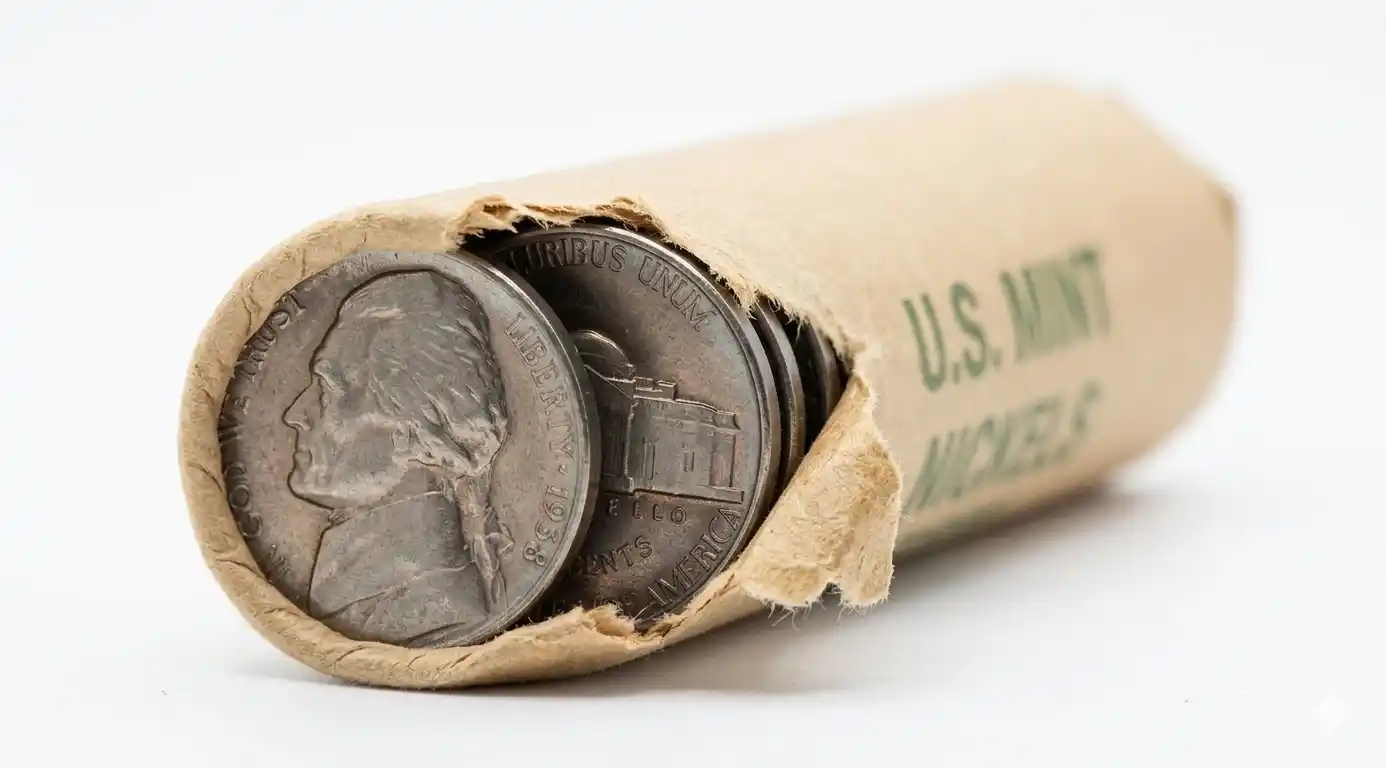
Before buying, do you how many nickels are in a roll?
Technical Parameter | Metric Value |
Total Coin Count | 40 units |
Cumulative Face Value | $2.00 |
Designated Wrapper Color | Blue |
Metal Content Mass | 200.00 grams |
Automated minting lines execute the filling of paper tubes with a 0.1% margin of error.
Empty paper wrappers weigh approximately 1.25 grams.
Mass measurement serves as the primary method for verifying roll authenticity in cash offices.
Standard banking boxes accommodate fifty of these individual rolls.
Physical Properties of the Jefferson Nickel
Modern five-cent coin production follows strict legal requirements regarding dimensions.
These characteristics have remained unchanged since 1938.
Unit Specifications:
Base Material: Alloy of 75% Copper and 25% Nickel
Object Mass: 5.000 grams
Circle Diameter: 21.21 mm
Edge Height: 1.95 mm
Rim Type: Plain
Maintaining these dimensions remains critical for the functionality of coin slots in vending hardware.
Diameter deviations exceeding 0.05 mm cause coins to jam within sorting mechanisms.
Plain edges reduce manufacturing costs for dies compared to reeded denominations.
Distribution Chain: From Mint to Bank
Cash distribution involves multiple stages of packaging and transportation.
System efficiency relies heavily on the durability of the containers.
Striking and initial bulk bagging into sacks of 4000 coins
Transport to specialized third-party wrapping facilities
Formation of 40-count rolls utilizing blue-coded wrappers
Bulk packing into cardboard boxes containing 50 rolls each
Distribution to bank branches via armored logistics vehicles
Using paper tape with adhesive edges prevents accidental opening during transit.
Wide adoption of transparent plastic tubes for multi-use purposes occurred by 2026.
Such packaging allows for visual confirmation of the count without breaking the seal.
Rare Issues: 2025–2026 Mintage and Price Statistics
Value for coins inside a roll depends on market supply scarcity.
Auction records confirm consistent price appreciation for specific dates.
Year and Mint | Condition | 2025 Price | 2026 Price | Growth |
1913 Liberty Head | PR66 | $4,520,000 | $4,850,000 | +7.3% |
1916 Buffalo (DDR) | MS64 | $45,000 | $48,200 | +7.1% |
1938-D Jefferson | MS68 | $540 | $585 | +8.3% |
1950-D Jefferson | MS67 | $720 | $780 | +8.3% |
Average annual value growth for Gem Uncirculated categories stays around 7.5%.
Decreased striking rates in 2024 sparked roll shortages in several states.
Professional dealers report increased demand for sealed boxes from recent years.
Full Steps Evaluation: Technical Quality Criteria
Jefferson nickel assessment includes a specific detail parameter for the reverse side.
Striking depth on the steps of the Monticello building directly impacts final valuation.
→ New die installation → Perfect strike → Six complete steps
→ Extended die usage → Micro-relief wear → Loss of detail
→ Final grading → Full Steps designation → Price increase of 200% — 500%
Full Steps status for the 1953 San Francisco issue remains extremely scarce.
Market prices for such specimens in 2026 exceed $22,000.00.
Standard coins without this detail trade near $15.00.
Mathematical probability of finding this quality in a standard bank roll is 1 in 850,000.
"Wartime Nickel" Technology 1942–1945
World War II forced the government to temporarily modify the metallurgical formula.
Removing Nickel from the composition was necessary for defense industry requirements.
Metal Ratios in Wartime Coins:
Silver: 35%
Copper: 56%
Manganese: 9%
Total coin mass was maintained at 5.000 grams by balancing these proportions.
Silver content in a single roll of these coins is valued at $155.00 in 2026.
Investment firms acquire these rolls as a hedge against currency inflation.
Price premiums for uncirculated wartime coins currently sit at 45% above metal value.
Production Dynamics in the 2020s
Five-cent coin mintage volumes show a steady downward trend.
Expanding electronic payment systems reduce the necessity for small change.
Period | Total Mintage (Billions) | Year-over-Year Shift |
2020 | 1.62 | -5% |
2021 | 1.58 | -2.5% |
2023 | 1.24 | -21.5% |
2025 | 1.05 | -15.3% |
Production falling by 15.3% in 2025 marked a decade-low performance.
Reduced supply of new rolls leads to a gradual increase in their market premium.
Banking reserves in 2026 consist primarily of coins from previous years.
Mint Error Classification
Manufacturing mistakes create unique objects within standard packages that can be determined with the coin identifier.
Each defect follows a clear technical description.
Off-Center Strike: planchet misalignment relative to the die, a 50% shift with a visible date increases value to $150.00
Double Die: overlapping images from a hubbing error during die creation 1939 specimens with doubled lettering on the reverse start at $400.00
Die Crack: cracks appearing on the working surface of the die, raised lines on the coin surface add between $10.00 and $50.00 in value
Clipped Planchet: incomplete metal disk before striking pricing ranges from $25.00 to $120.00 depending on the missing area
Finding these errors upon opening a roll boosts the overall return on the lot.
Implementation of optical control systems at mints in 2026 reduced error output by 40%.
Scarcity makes modern errors significantly more valuable for the current market.
Asset Protection and Storage Methodology
Copper and Nickel alloys react to chemical changes in the surrounding environment.
Surface oxidation leads to an irreversible loss of collectible grade.
Roll Conservation Rules:
Maintain air humidity levels below 35%
Eliminate direct exposure to sunlight
Use polypropylene containers free from PVC
Prevent sudden temperature fluctuations
Nickel reacts with sulfur compounds to form dark spots on the surface.
Utilizing professional air dehumidifiers is mandatory for large-scale storage.
Climate control hardware costs are justified by preserving high-grade coin categories.
5-Cent Production Economics in 2026
Manufacturing costs for a single coin significantly exceed its face value.
Treasury reports address this factor annually.
→ Rising Copper prices → Increased striking costs → 8.2 cents per coin
→ Logistics expenses → Additional 0.5 cents per unit → 8.7 cents total
→ Resulting state loss → 3.7 cents on every issued coin
Total annual losses from 5-cent production exceed $90 million.
Government officials are considering a shift to Steel blanks with a thin coating.
Implementation of this plan would turn current Copper-Nickel rolls into hoard targets.
Liberty Head Nickels Analysis
This series saw production between 1883 and 1912.
Most surviving rolls were assembled by private collectors at a later date.
1885 Issue: mintage of 1,476,490 units Price for an MS63 specimen reaches $4,200.00
1886 Issue: mintage of 3,330,290 units Value for a similar quality coin equals $1,150.00
1912-S Issue: first western coast striking Market price in 2026 holds steady at $2,800.00 for MS60 grade
Missing the word "CENTS" on 1883 issues led to a famous gold-plating fraud.
Known as "Racketeer Nickels," these are valued at $150.00 as historical artifacts.
Authentic Liberty Head rolls represent an extreme rarity for 2026.
Buffalo Nickels: Dating and Wear Issues
James Fraser's design features high relief across the entire surface.
Placing the date on a raised area caused rapid wear during circulation.
→ Active circulation → Date digit abrasion → Loss of numismatic value
→ Acid application → Artificial date restoration → 90% price reduction
→ Intact date in a roll → Sign of high strike quality → 300% premium
1926-S Buffalo Nickel mintage is recognized as one of the scarcest in 2026.
MS65 specimens reached $145,000.00 at recent auction events.
Presence of such a coin within a roll increases its valuation by thousands of times.
Professional Certification
Verifying coin authenticity in 2026 utilizes laser spectroscopy techniques using the free coin apps.
Third-party laboratory services act as a guarantee for transaction security.
PCGS Laboratory: global leader in coin grading Evaluating a full roll unit by unit costs from $800.00
NGC Laboratory: direct competitor with comparable standards Certified coins sell 25% faster than raw counterparts
Hermetic Capsules: protection against mechanical damage Plastic capsule lifespan without clouding reaches 50 years
Investors prefer purchasing coins in original holders with individual serial numbers.
Laboratory databases are available for instant verification via mobile applications.
Certificate falsification is prevented through holographic labels and blockchain records.
Silver Detection Probability in Circulation
Searching for valuable coins in modern bank rolls is known as "Coin Roll Hunting."
This activity follows the laws of mathematical statistics.
Silver Nickel discovery rate: 1 per 120 rolls
Buffalo Nickel discovery rate: 1 per 450 rolls
Mint error discovery rate: 1 per 1500 rolls
Efficiency for searching decreased in 2026 due to AI usage in sorting centers.
Robotic systems identify metal through electrical conductivity and remove Silver.
Manual searching in retail bank networks has become less productive as a result.
Time costs for processing a box of coins rarely align with the value of the finds.
The Future of 5-Cent Coins in the USA
Payment system evolution threatens the existence of low-denomination physical cash.
Canadian experience in removing the penny serves as a potential model for the US.
→ Reduced cash usage → Lower roll demand → Packaging line closures
→ Rising collectible value → Shift to asset category → Market scarcity formation
→ Metal composition reform → Cheaper production → Physical property changes
Five-cent coins remain a key element of retail trade in 2026.
The 40-count packaging standard stays relevant due to infrastructure compatibility.
Studying individual roll parameters allows for identifying promising investment positions.